HELLDIVERS (2015): The Twin-Stick Shooter That Made Friendly Fire Fun
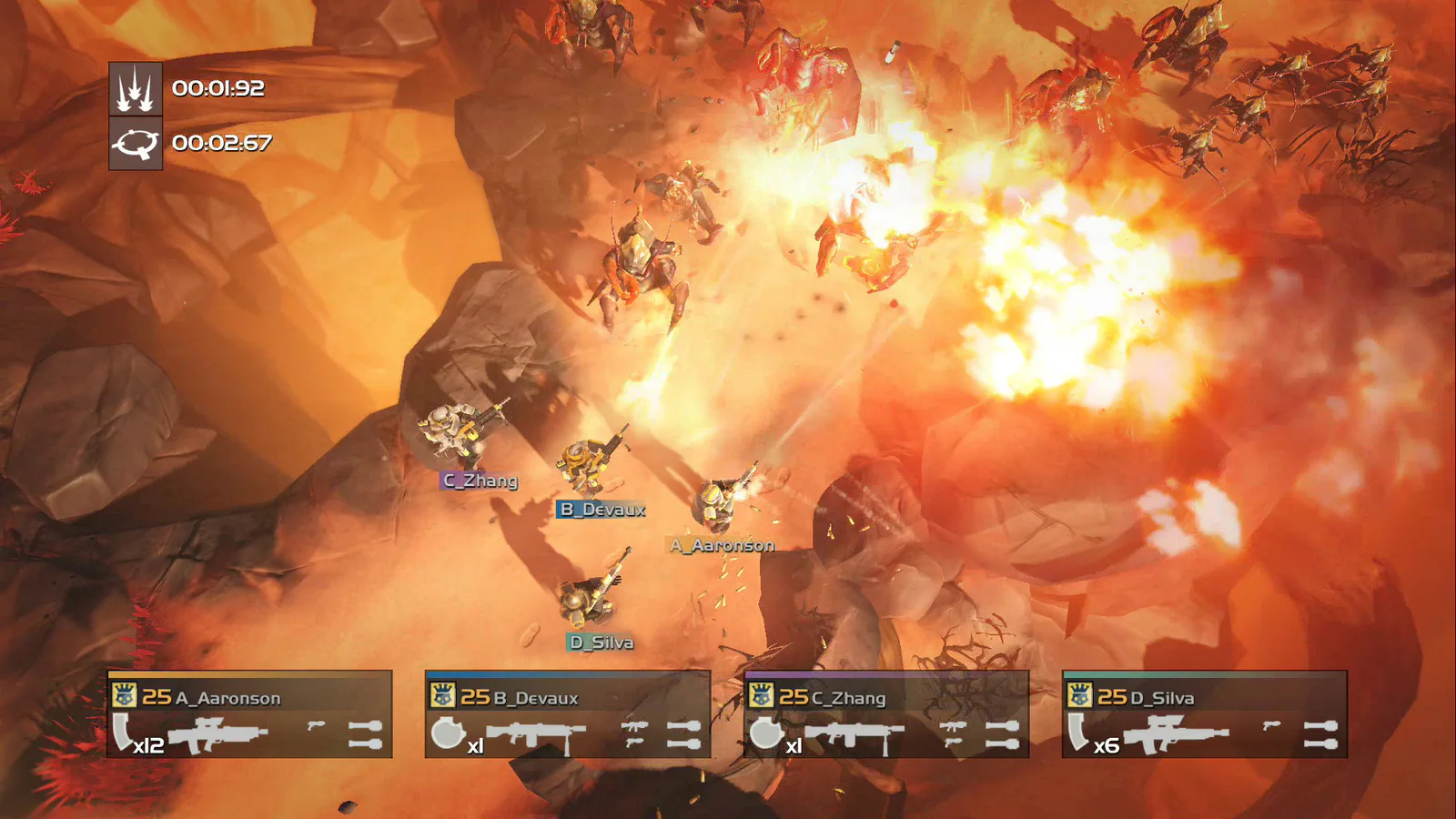
Image: Official gameplay screenshot — Arrowhead Game Studios and PlayStation
Most twin-stick shooters ask you to fear what is on screen. The 2015 original HELLDIVERS asked you to fear the person on your couch. Arrowhead Game Studios built a top-down co-op shooter where your own airstrikes, sentries, and stray bullets could delete a teammate in a single careless second, and then dared four players to like it. Somehow, they did. This is the game that quietly wrote the rulebook a global phenomenon would later shout from the rooftops.
Development: Arrowhead and the Magicka bloodline
To understand HELLDIVERS, you have to understand the studio’s earlier cult hit, Magicka. That 2011 game was chaotic co-op comedy built on a spell system so open that friends spent more time incinerating each other than any enemy. Arrowhead learned a lesson there that most developers would have patched out: shared danger creates shared stories.
HELLDIVERS took that instinct and pointed it at satirical military science fiction. Directed by studio co-founder Johan Pilestedt, the game launched on March 3, 2015 for PlayStation 3, PlayStation 4, and PS Vita, with a Windows release following in December (see Wikipedia). Sony Computer Entertainment published it, and the studio built it on Autodesk’s Stingray engine. The premise was pure Starship Troopers pastiche: you are a disposable trooper of Super Earth, spreading Managed Democracy across the galaxy against Bugs, Cyborgs, and the Illuminate.
Pilestedt has been blunt about the design logic behind the game’s most notorious feature. As he told PlayStation.Blog, “If your bullets can kill enemies, and the enemies can kill you, then logic dictates that your bullets must also be able to kill your friends.” That single sentence is the whole philosophy.
Why it matters: friendly fire as a design pillar
Plenty of co-op games treat teammates as invulnerable ghosts you can shoot through. HELLDIVERS refused. Friendly fire is permanently on, and crucially, it extends to everything you call down: airstrikes, orbital barrages, resupply pods, and turret sentries. A misplaced sentry will happily gun down the ally who ran in front of it.
The genius is that this turns cooperation into a real skill rather than a menu option. The second pillar, stratagems, makes that skill legible. Instead of pressing a button for an airstrike, you enter a short directional code on the d-pad, up-down-left-right and so on, while standing still and exposed. It is a tiny, tense minigame in the middle of a firefight. Pilestedt notes the stratagems were “based on real world examples” and grew iteratively: designers would get bored, then add another toy. The result is a twin-stick shooter where positioning, communication, and input discipline matter as much as aim.
How it feels: spacing, teamkills, and the war that never ends
Playing HELLDIVERS well feels like a slow-motion negotiation over personal space. You learn to fan out, because clustering means one bug breach or one badly aimed grenade wipes the squad. You call your stratagem, watch the beacon land, and pray nobody sprints into the blast radius. The best runs have a strange choreography to them; the worst ones end with everyone laughing at a single button that killed all four players.
Difficulty scales through planet selection rather than a simple slider, letting a squad choose easy or hard worlds across procedurally generated missions against three enemy factions. Above the moment-to-moment chaos sits the galactic war, a persistent meta-layer where every player’s completed mission feeds a shared campaign map. Your individual extraction, successful or catastrophic, nudges a front line that the entire community is pushing together in real time. It is a small dose of purpose that keeps you queuing “just one more drop.”
Lesser-known: the cross-play nobody else was doing
Here is the fact that rarely makes the highlight reels. HELLDIVERS shipped with full cross-play and cross-save across PlayStation 3, PlayStation 4, and PS Vita, so a PS4 player, a PS3 player, and a Vita player could drop into the same squad and share the same galactic war, as documented on Wikipedia. In 2015, that kind of seamless three-platform play within one console family was genuinely rare, years before cross-play became an industry expectation. It also happened to be one of the first Sony-published titles to reach PC in nearly two decades. For a mid-size studio’s top-down shooter, that was a quietly bold piece of engineering.
Legacy: the bridge to Helldivers 2
For years HELLDIVERS was a beloved secret, the kind of game people evangelized to skeptical friends. Then Helldivers 2 arrived in 2024 and detonated into a mainstream sensation. The sequel swapped the top-down camera for over-the-shoulder third person, but Pilestedt is clear that the team wanted to preserve the essential elements: visceral combat, friendly fire, and the fragility of a lone human against overwhelming odds.
Everything people adored about the sequel, the stratagem codes, the teamkill comedy, the community-driven war, was invented here in the twin-stick original. HELLDIVERS is not a rough draft. It is the complete thesis, just delivered from a bird’s-eye view. If you want to see where a cultural juggernaut came from, this is the source code.
For more essential co-op and top-down design, see our pillar guide to the Top 10 Twin-Stick Shooters of All Time, and compare notes with the arcade cruelty of Smash TV and the vehicular mayhem of Renegade Ops.
FAQ
Is the original HELLDIVERS the same as Helldivers 2? No. The 2015 original is a top-down twin-stick shooter; Helldivers 2 (2024) is a third-person shooter. They share stratagems, friendly fire, and the galactic war, but play very differently.
Can you turn friendly fire off? No. Friendly fire is permanently active, including on your own airstrikes and sentries. Learning to manage it is central to the game.
Do you need a full squad to play? No. It supports solo and drop-in co-op up to four players, though the tension and comedy peak with a full team.
Sources
- Helldivers, Wikipedia
- Helldivers 2: how Arrowhead turned the twin-stick shooter original into a bombastic PS5 sequel, PlayStation.Blog
- Arrowhead Game Studios
helldiversarrowheadco-optwin-stick