Nex Machina: The Arcade Purist's Twin-Stick Masterpiece
Some games try to give you everything. Nex Machina tries to give you one thing, sharpened to a razor, and then dares you to survive it. Released by Finland’s Housemarque in June 2017, it is a top-down twin-stick shooter with no skill trees, no loot grind, and no filler. What it has instead is speed, exploding voxels, and a scoring system that will happily punish you for being greedy. It is also, in a very direct sense, a love letter from one generation of arcade designers to the man who started the whole conversation.
A Handshake at a Cocktail Bar
The story of Nex Machina begins with two parties who admired each other from a distance. Housemarque had just scored a hit with Resogun, and Eugene Jarvis, the designer behind Defender, Robotron: 2084, Smash TV, and Total Carnage, was collecting a Pioneer Award at the 2014 D.I.C.E. Awards. They met there, and as Jarvis later told it, the collaboration kicked off in the least professional way imaginable: “It all started at a cocktail bar, which is not a good place to start things off” (Game Developer).
This was Housemarque’s first external collaboration with anyone outside the studio, and Jarvis did not parachute in to run the show. He worked as a creative advisor, feeding ideas to the Finnish team from his base in Chicago, roughly 4,400 miles and seven time zones away. The distance was awkward for meetings but, by the team’s account, made every session feel like it mattered. Jarvis supplied the fiction: robots grow smart enough to resent us, then rebel, a premise he tied to real anxieties about handing our privacy to convenient gadgets. Housemarque supplied the craft, wrapping it all in an aesthetic they called “cablepunk,” a grimier cousin of cyberpunk soaked in 1980s arcade neon.
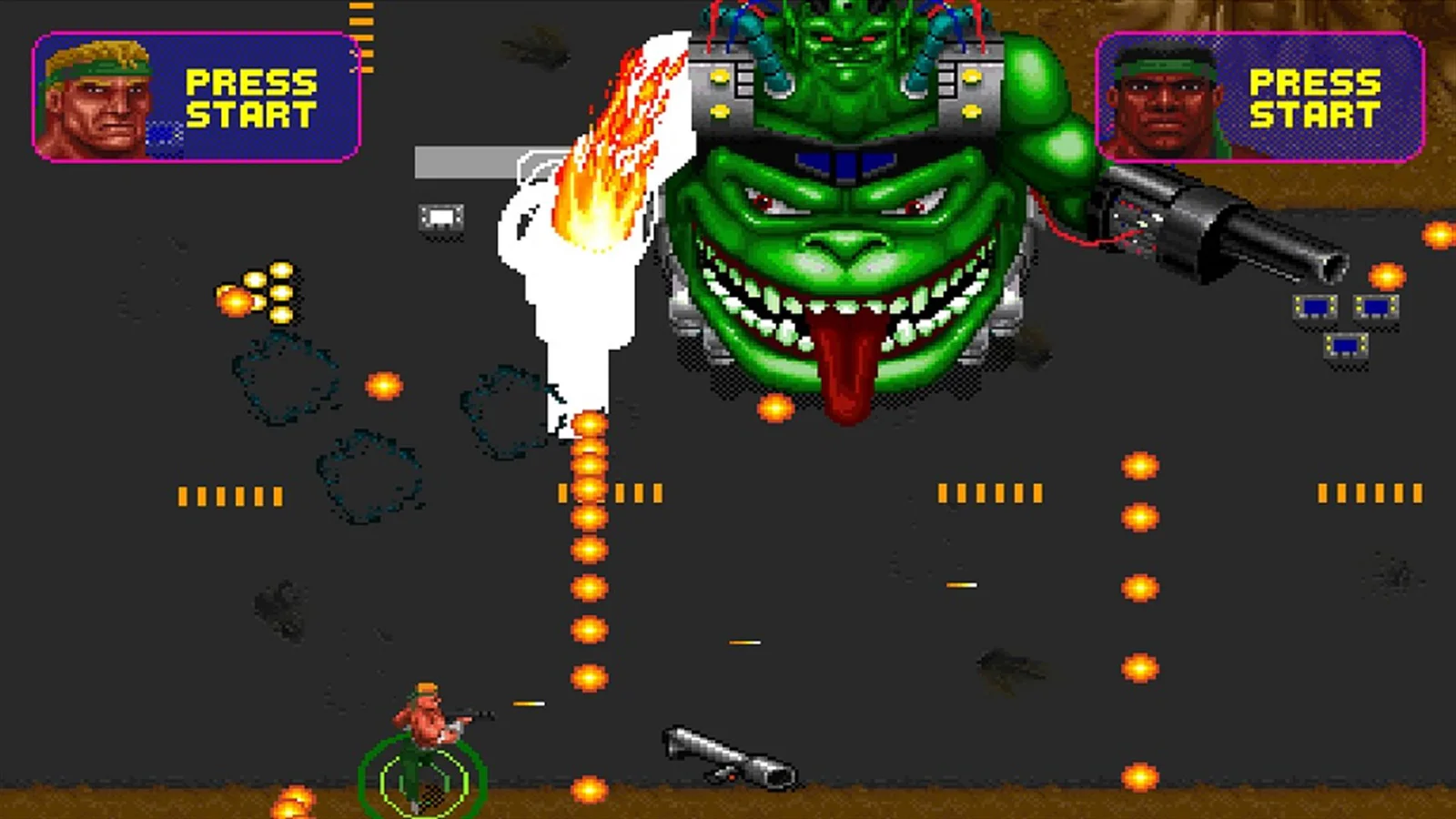
Director Harry Krueger led the build, with Ari Pulkkinen scoring it. The guiding rule was arcade purism: simple, focused mechanics with nothing hanging off the edges to distract you. Jarvis reckoned Nex Machina sat closest to his own Smash TV and Total Carnage, though Housemarque layered in the bullet-hell density that had become their signature.
Why It Matters to the Genre
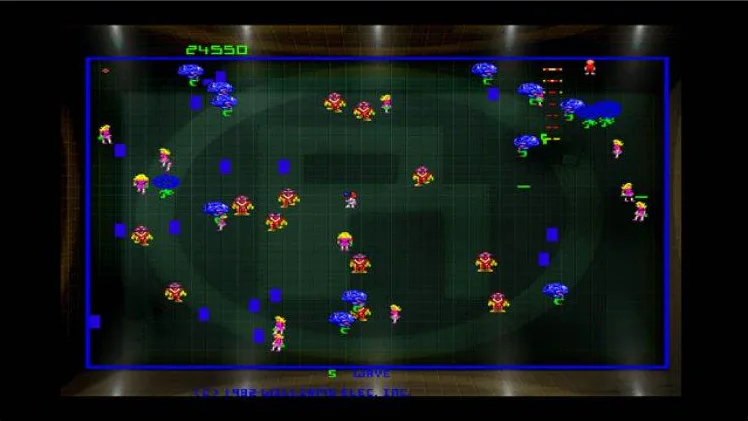
The twin-stick shooter owes its DNA to Jarvis’s Robotron: 2084, so having him consult on a modern flagship gives Nex Machina a genuine claim to the bloodline. It is not cosplay. The game inherits Robotron’s core tension, the constant negotiation between where you are shooting and where you are running, and then modernizes it without softening it.
Crucially, Housemarque resisted the temptation that sank a lot of 2010s action games: the urge to bolt on progression. There is no character leveling here, a deliberate break from their own 2016 title Alienation. That choice keeps every death honest. You do not fail because your numbers were too low; you fail because you were in the wrong pixel at the wrong frame. In an era when nearly everything wanted to be a live-service treadmill, Nex Machina argued that a tight loop and a leaderboard were still enough. If you want the wider lineage, our Top 10 Twin-Stick Shooters of All Time traces the line from Robotron 2084 forward.
How It Feels to Play
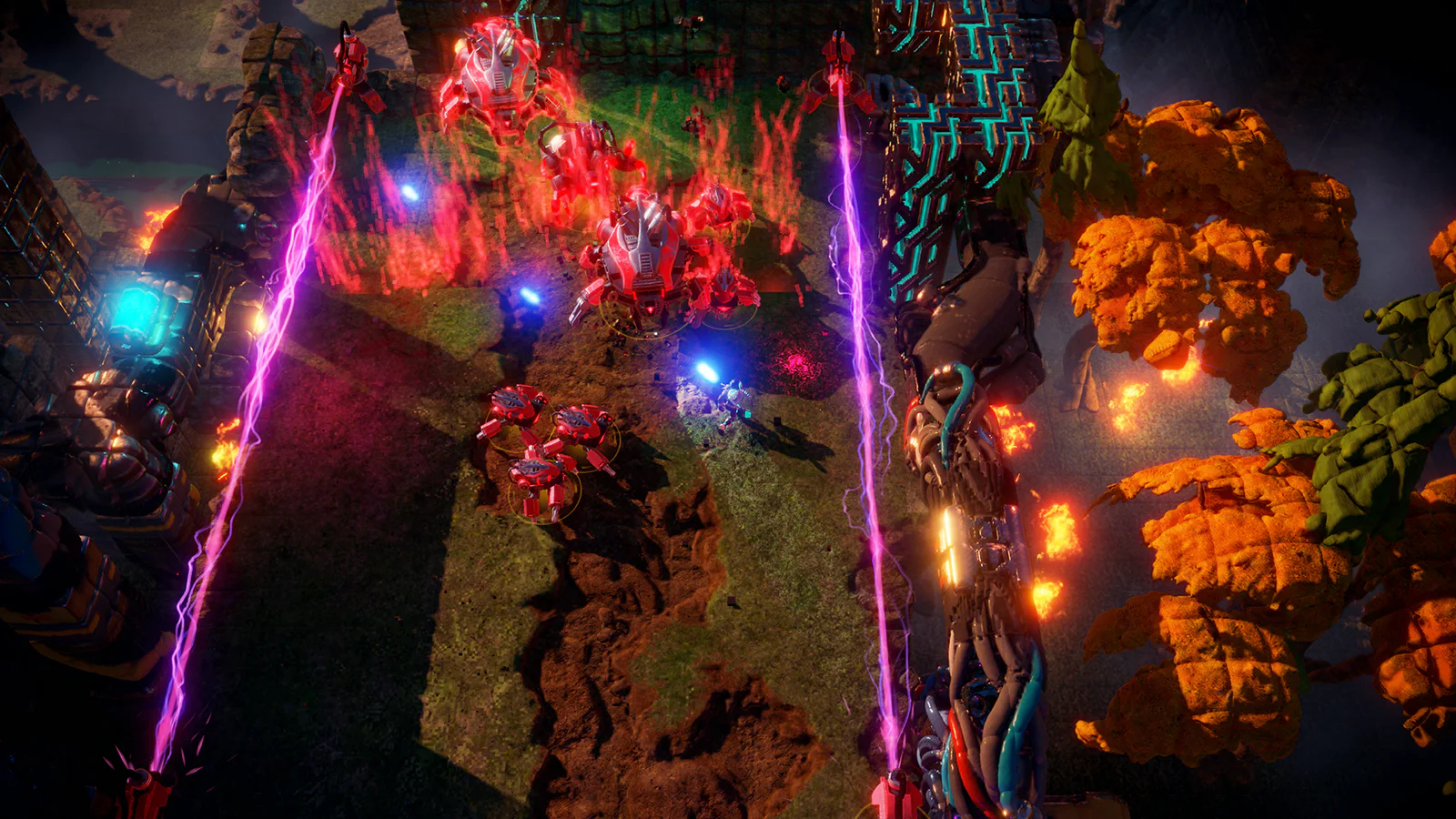
Fast. Then faster. You drop into a room, the walls and floor built from voxels, and within seconds enemies swarm from every edge. Housemarque used an enhanced version of Resogun’s engine, layering in Signed Distance Fields so that meshes dissolve into particles with a smoothness that makes destruction feel physical. Everything you shoot seems to come apart, and the screen fills with debris and light.
Your two tools are your twin sticks and a dash. The dash is the whole game in miniature: a short burst that slips you through a laser or a closing gap, with just enough cooldown that panicking with it gets you killed. Learn its rhythm and you feel untouchable. Lean on it and it abandons you.
Scattered through each room are humans to rescue, a direct nod to Defender and Robotron. Grabbing them is optional, and that is the point. The scoring rewards you for saving every last one and for chaining kills, which means the game is constantly offering you a bad idea: stay a half-second longer, sweep up that human, extend the combo. Take the bait too often and the difficulty, which is steep by design, collapses on you. Critics were blunt about the challenge and just as quick to call it fair. It is a game that hurts on purpose and never feels cheap while doing it.
The Lesser-Known Chapter
Here is the twist most players missed. Nex Machina was not just made by the arcade faithful; it was very nearly the last thing they made in that faith. Roughly four months after release, in November 2017, Housemarque published a blunt post titled “Arcade Is Dead” on their own site, announcing they were stepping away from the arcade shooter genre because the audience, commercially, simply was not there to sustain it (Housemarque). Nex Machina, a game built as a tribute to the entire form, effectively doubled as its farewell. The studio pivoted, and that pivot eventually produced the PlayStation 5 hit Returnal, which smuggled Housemarque’s arcade instincts into a big-budget roguelike. The genre they buried never actually left their bloodstream.
FAQ
Is Nex Machina a sequel to Resogun? No. It shares an engine lineage and studio, but it is a standalone twin-stick shooter with its own world and design goals.
How involved was Eugene Jarvis? He served as a creative consultant and idea source rather than a hands-on developer, contributing the fiction and design philosophy while Housemarque built the game in Finland.
Is it worth playing if I am not a scoring expert? Yes. The moment-to-moment shooting and dashing are thrilling on their own, and the leaderboard chase is optional depth you can grow into.
Sources
- Game Developer: The unique collaboration behind Nex Machina
- Wikipedia: Nex Machina
- Housemarque: Arcade Is Dead
- Housemarque: Nex Machina is finally here
- Related: Geometry Wars: Retro Evolved
nex-machinahousemarquearcadescore-attack