Robotron: 2084 and the Birth of the Twin-Stick Shooter
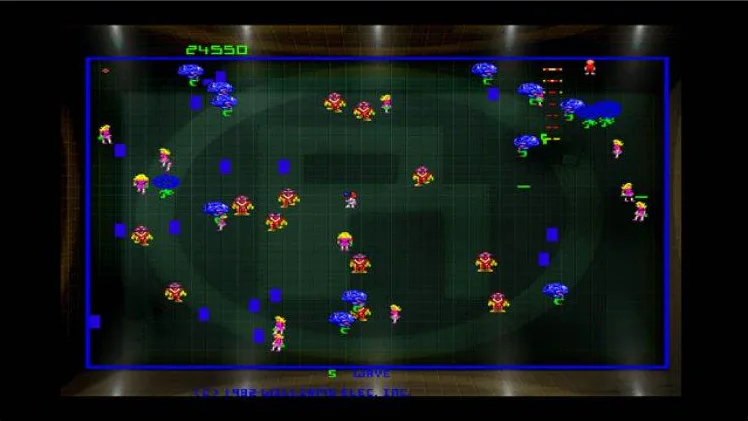
Image: Robotron: 2084 cabinet — photo by Piotrus, CC BY-SA 3.0, via Wikimedia Commons
Some games age into curiosities. Robotron: 2084 refuses to. Drop a quarter into an original Williams cabinet today and the panic hits within seconds, exactly as it did in 1982. Two sticks, no bullets to conserve, and a screen that keeps filling with things that want you dead. It is one of the purest action games ever built, and it is the reason we have a genre to write about at all.
Where Robotron came from
By 1981, Eugene Jarvis and Larry DeMar had already given Williams Electronics a monster hit in Defender. They spun off into their own two-man studio, Vid Kidz, working out of a small office on North Halsted Street in Chicago, and set out to build something in a completely different direction. The result took roughly six months, programmed in 6809 assembly on a Gimix development machine. According to The Arcade Blogger’s development history, the art and animation were knocked out in about two weeks; the remaining four-plus months went entirely into playtesting and tuning. That ratio tells you everything about why the game feels the way it does.
The control scheme has an origin story that sounds too neat to be true, except it is documented in Jarvis’s own words. He had broken his right hand badly in a car accident, the impact traveling through the steering wheel, and was laid up for weeks. That injury, combined with a nagging frustration that Stern’s Berzerk forced you to move toward an enemy in order to shoot it, pushed him toward separating the two actions. One stick to run. One stick to aim. The dystopian framing (a robot uprising in the year 2084, humanity down to its last family) borrowed openly from Orwell’s Nineteen Eighty-Four, Berzerk, and Space Invaders, but the feel was brand new.

Why it matters to the genre
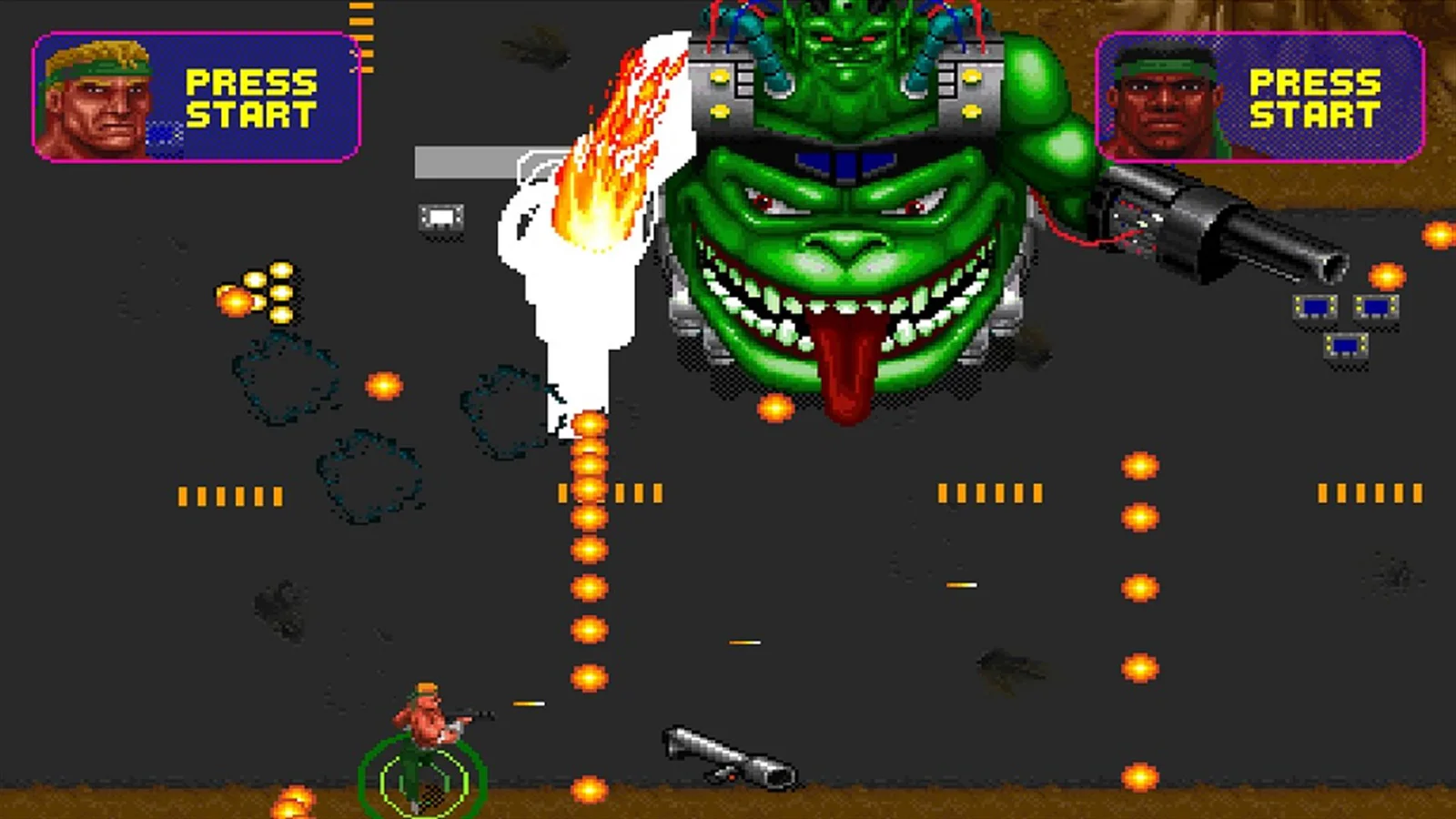
Plenty of games had used two sticks before. What Robotron did was make the two-stick idea feel inevitable, and it sold enough cabinets (around 19,000 by most counts) to burn the pattern into an entire industry. Movement and aiming became independent axes, which meant the designer could finally throw enemies at you from every direction at once without the control scheme falling apart. That single decision is the load-bearing wall of the whole category. When you play Smash TV, also a Jarvis joint, or a modern indie darling, you are playing a descendant of these two sticks.
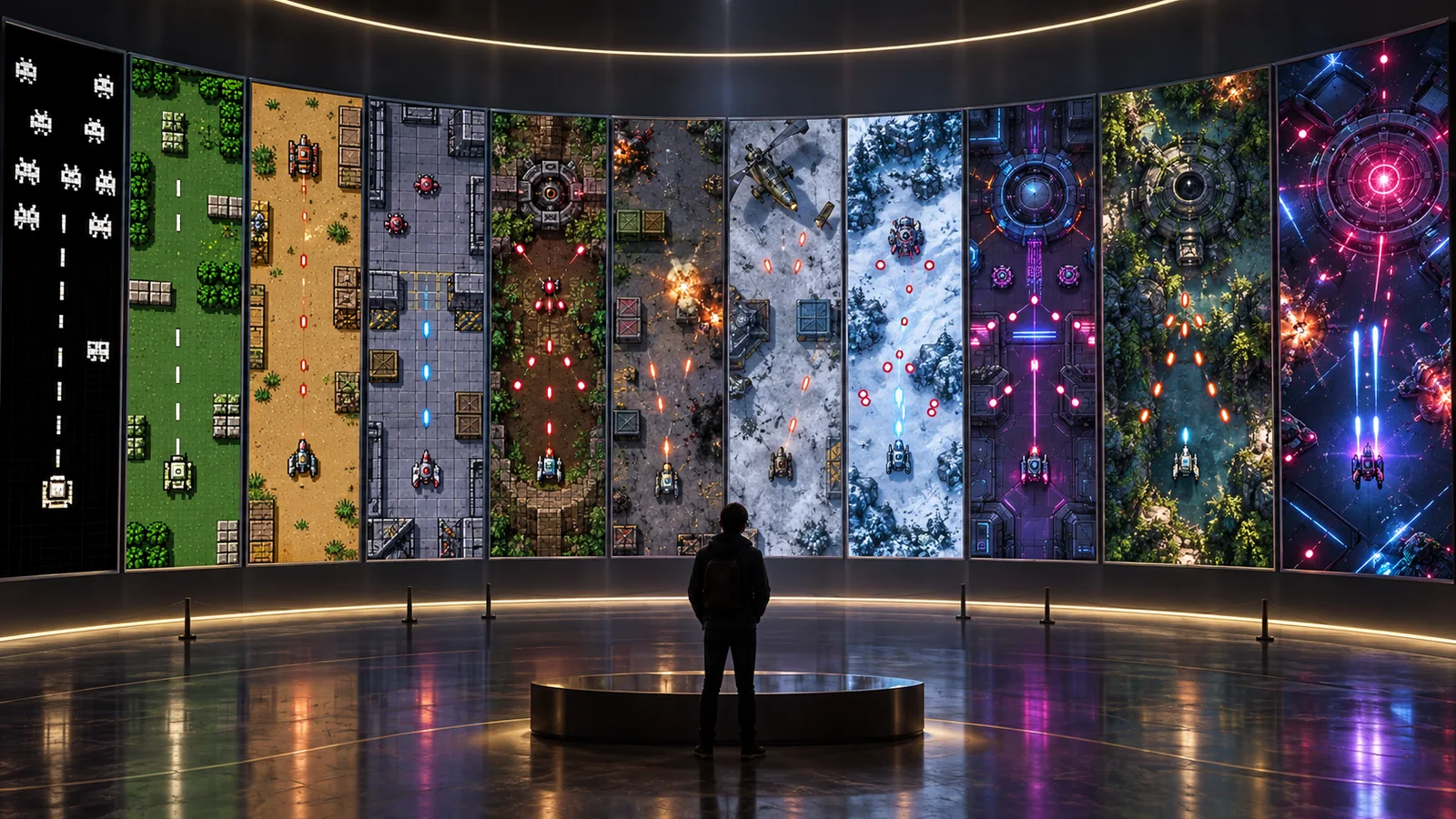
If you want the wider family tree, we mapped it in our Top 10 Twin-Stick Shooters of All Time. Robotron sits near the root of it.
How it feels to play
Here is the thing about those dual eight-way sticks: they turn your brain into two independent processors. Your left hand solves a spatial puzzle, threading a survivable path through a closing net of Grunts. Your right hand is doing something completely different, sweeping fire in whatever direction keeps you alive. Beginners tend to lock both hands into the same direction, running and shooting forward like it is a normal shooter. The moment it clicks that you can flee left while hosing right, the game opens up.
The enemy roster is a masterclass in readable chaos. Grunts march straight at you and speed up over time. Hulks are indestructible and can only be shoved, so they exist purely to block your escape routes. Brains are the nasty ones, because they turn the surviving humans into homing Progs while you scramble to reach the family first. Electrodes sit still and kill you if you brush them. Spheroids and Quarks spawn Enforcers and Tanks. Nothing needs a tutorial; the behavior is the explanation.
Rescuing Mommy, Daddy, and Mikey is where the risk-reward tension lives. You do not have to save them, but touching a human banks points that escalate wave over wave, from 1,000 up to 5,000, so a greedy player detours into danger for the score. The pacing is relentless and, honestly, a little cruel. Waves reset your position dead center and immediately surround you, a design choice Jarvis described as being about instilling panic through confinement. The difficulty is old-arcade brutal, built to eat quarters, yet it never feels cheap because every death is legibly your own fault.
Legacy and influence
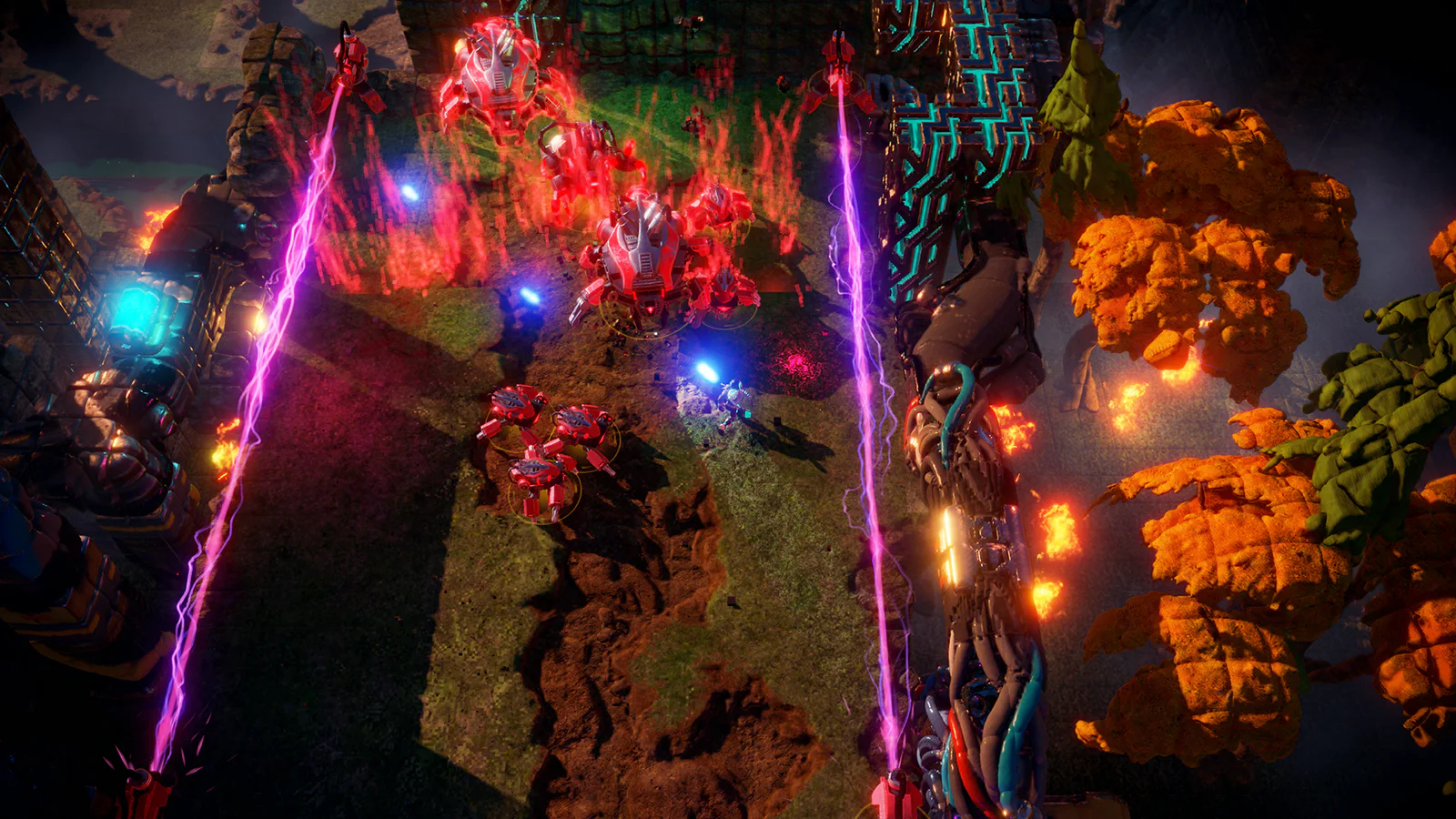
Robotron’s DNA is everywhere. The direct line runs through Smash TV in 1990 and then goes quiet for a decade before the twin-stick idea roars back with Geometry Wars: Retro Evolved on Xbox Live Arcade, which reintroduced a generation to the two-stick rush on a controller instead of a cabinet. From there the floodgates opened, right up through Housemarque’s Nex Machina, a game Jarvis personally co-designed as a deliberate spiritual successor. Forty years on, the man who broke his hand in a car crash is still refining the same core loop.
Lesser-known: the Mikey bug that became strategy
Here is a fact that even a lot of Robotron players do not know. On the first Brain wave, a genuine programming bug caused every Brain on screen to fixate on and reprogram the child, Mikey, before touching the other humans. As documented in The Arcade Blogger’s development history, the team left the glitch in because it accidentally created a huge scoring opportunity: a skilled player who protected Mikey through that wave could bank well over 100,000 points. An outright coding error became a beloved piece of competitive strategy. That is the kind of happy accident you only get from a game that spent four months in playtesting.
FAQ
Was Robotron: 2084 the first twin-stick shooter? No, dual-joystick controls predate it, but Robotron popularized the scheme and is the game credited with cementing it as a genre foundation. Almost every later twin-stick shooter traces back to it.
Who made Robotron: 2084? Eugene Jarvis and Larry DeMar, working as Vid Kidz and published by Williams Electronics in 1982. The same duo had previously created Defender.
Why does the year 2084 appear in the title? It is a nod to George Orwell’s Nineteen Eighty-Four, updated a century forward to a future where robots have turned on their creators.
Credit where it is due: Eugene Jarvis, Larry DeMar, and Williams Electronics built something that has outlived most of the machines it shipped on. For the full record, see the sources below.
Sources
- https://en.wikipedia.org/wiki/Robotron:_2084
- https://arcadeblogger.com/2020/06/27/the-development-of-robotron/
- https://www.gamedeveloper.com/design/the-history-of-robotron-2084---running-away-while-defending-humanoids
- https://en.wikipedia.org/wiki/Eugene_Jarvis
- https://www.raspberrypi.com/news/code-robotron-2084s-twin-stick-action-wireframe-38/
robotronarcadeeugene-jarvishistory